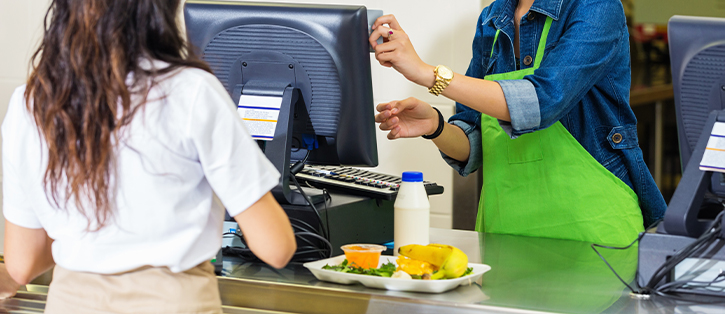
5 ways to track the health of your K–12 food service program

Understanding the day-to-day health of your K-12 food service operation is essential to ensuring its success. The right set of operational metrics can help you determine if you might be missing out on potential revenue, if your serving lines are running smoothly, and if your labor and food dollars are being used most effectively.

Below is a practical framework around five key operational areas:

Read More ⟶

K-12 School Budgets Are Tight — Here’s Why Tracking Meal Sales Matters More Than Ever

Budgets are tight, food and labor costs are volatile, and staffing is hard. In this challenging environment, school nutrition programs can’t afford to run in the red for very long. Tracking every meal sold does more than tidy up reports. It protects revenue, speeds service, reduces waste, and strengthens compliance. The good news is most of this can be managed with a modern cafeteria POS (point of sale) solution.

Read More ⟶

A perfect pairing: Springfield Public School’s journey with MCS

In the world of school nutrition, efficiency and accuracy are crucial. For Springfield Public Schools in Massachusetts, delivering nutritious meals to over 28,000 students across 66 public schools and 12 charter/parochial schools is no small feat. We recently had the opportunity to visit Springfield Public Schools, where we saw firsthand how they utilize MCS to manage their operations from Back of House to Front of House. 

Read More ⟶

The how to’s for managing meal debt in 2023 and beyond

In summer 2022 universal free meal waivers expired and, due to this change, many school nutrition programs are again faced with the challenge of managing student meal debt. In a November 2022 survey of school nutrition directors conducted by the School Nutrition Association, districts reported meal debt as low as $15 and as high as $1.7 million with an accumulated debt totaling over 19 million dollars nationwide. 

Read More ⟶

6 ways your POS software can help with staff shortages

Choosing the right Point of Sale software for your school district can be a daunting task. With so many factors to consider, from data security to user experience, it's easy to get lost in the weeds. However, one crucial factor that often goes overlooked is how your POS software can help you deal with staff shortages.

In fact, according to the School Nutrition Association's 2023 School Nutrition Trends Report, over 90% of schools report staff shortages as a challenge. Hear from our Nutrition experts, Mike Walker and Katy Munna, as they discuss how your POS software can help alleviate the hardship of staff shortages.

Read More ⟶

Experience It All at Connect 2023 – Here’s What To Expect

Connect 2023 is almost here! Join us in Nashville March 21-22 or virtually March 27-30 for our largest training conference of the year. This is your chance to learn more about your Heartland products, connect with peers, meet with product experts, and so much more. Here are a few things to look forward to:

Read More ⟶

How To Properly Clean & Disinfect Your Point of Sale Hardware

Now more than ever, making sure every surface in your cafeteria remains clean and disinfected when students return is critically important. The same holds true for all of your serving line hardware, including POS terminal/tablets, pin pads, cash drawers, keyboards, and mice.

We have worked closely with our vendors to develop the guidelines outlined below showing how to properly clean and disinfect your point of sale hardware.  If you’re not a Heartland customer and you purchased equipment elsewhere, please refer to the manufacturer for specific instructions. 

Read More ⟶

A "Sound" Approach to Speeding Up Serving Lines

 
Lunchtime is often considered crunch time for school food service staff - for more reasons than one! Serving meals quickly and efficiently, while also making sure students have time to eat, can be a challenge for many schools. That's why any feature or method that can help speed up your serving lines, even by a few seconds, can be monumental.

One school district in Northern California found that simply using audio messages at their Point of Sale stations helped to increase their line speed and satisfaction among the students.

Read More ⟶

Better Point of Sale Reporting Starts with Your Serving Lines


In the '90s, the school nutrition industry started to embrace computerized Point of Sale (POS) systems as a way to better track what was being sold and make it easier to manage student accounts. Today, many school nutrition professionals believe the biggest value of their POS system is at the serving line. While this is true (after all, that is where the transaction is created), the real power of a POS system is in the reporting.

Reports are often underutilized and can provide more information than many folks realize. Beyond the basics of how many meals have been served or the total sales for a given period, reports can help you identify opportunities for operational improvement or areas for increased participation.

Making sure your serving lines are properly configured to reflect the way your schools serve meals and à la carte items will ensure you get the most from your POS reports.


Read More ⟶

4 Key Factors to a Successful Cafeteria POS Implementation

Implementing a new point of sale system in your cafeterias may seem like a daunting task, but it doesn’t have to be. With the right plan in place, you can keep your implementation on track to ensure a smooth rollout.

Read More ⟶