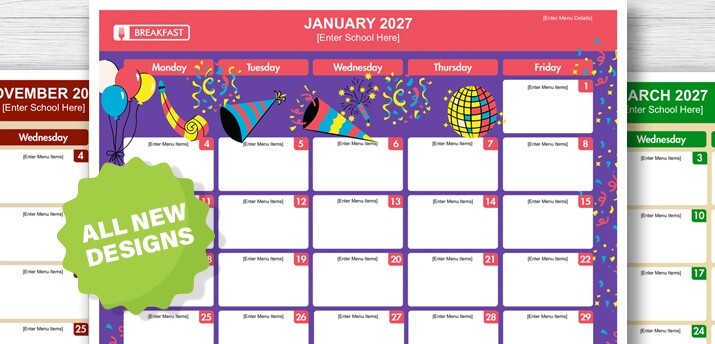
Our school menu templates are now available for the 2026-27 school year. This year, we have a brand new set of designs, as well as an ADA-friendly format option.



Fresh insights for school leaders
Our school menu templates are now available for the 2026-27 school year. This year, we have a brand new set of designs, as well as an ADA-friendly format option.

Understanding the day-to-day health of your K-12 food service operation is essential to ensuring its success. The right set of operational metrics can help you determine if you might be missing out on potential revenue, if your serving lines are running smoothly, and if your labor and food dollars are being used most effectively.
Below is a practical framework around five key operational areas:

Budgets are tight, food and labor costs are volatile, and staffing is hard. In this challenging environment, school nutrition programs can’t afford to run in the red for very long. Tracking every meal sold does more than tidy up reports. It protects revenue, speeds service, reduces waste, and strengthens compliance. The good news is most of this can be managed with a modern cafeteria POS (point of sale) solution.

As schools aim to provide a healthy and balanced diet for their students, dietitians play a crucial role in ensuring the school lunch program runs smoothly while keeping up with the changing trends and regulations. With so many students to manage, there are a number of common challenges that may be faced along the way. We spoke with a dietitian to learn about some of the biggest challenges and a few ideas to help you overcome them.

The USDA is always working to balance nutrition and taste in school meals, ensuring they are both healthy and delicious. In April 2024, the USDA revealed the final rule for updates to school nutrition standards,which will start to come into effect in the 2025-2026 school year and will need to be fully integrated by the 2027 school year.

Each year schools are responsible for collecting, tracking, and reconciling thousands of student payments across multiple programs. From lunch money to exam fees and everything in between, managing payment collection district-wide is typically a complex and decentralized process. Districts will often find that their school sites and student programs use various methods and software platforms to help them manage payment collection. The athletic department may have a specific application for registration fees, while the before and aftercare program uses another for their enrollment payments. That doesn't even account for all the areas where staff may still be manually collecting physical payments and paper forms, forgoing a software platform altogether.

According to SNA’s 2024 School Nutrition Trends Report, schools shared that staff shortages and rising costs are their programs' top two challenges. As schools look to navigate through these roadblocks, time is a valuable resource. Choosing which Point of Sale System you’re going to implement for your nutrition program is a big decision, and there are many things to consider. Let’s take a look at a few of the features that will not only help you run a smooth program, but save you time along the way.

In the world of school nutrition, efficiency and accuracy are crucial. For Springfield Public Schools in Massachusetts, delivering nutritious meals to over 28,000 students across 66 public schools and 12 charter/parochial schools is no small feat. We recently had the opportunity to visit Springfield Public Schools, where we saw firsthand how they utilize MCS to manage their operations from Back of House to Front of House.
A healthy lunch is more than just a meal. It fuels young minds and supports learning and growth. Every year during the second week of October, National School Lunch Week serves as a reminder that a well-balanced lunch is an essential part of every student's day. By showcasing the importance of a healthy lunch, we can encourage better eating habits while promoting overall wellness among students.
Connect 2023 is almost here! Join us in Nashville March 21-22 or virtually March 27-30 for our largest training conference of the year. This is your chance to learn more about your Heartland products, connect with peers, meet with product experts, and so much more. Here are a few things to look forward to: